
How Long It Takes To Train For An IRONMAN 70.3
Training for an IRONMAN 70.3 is often misunderstood. Many athletes assume that because the race is half the distance of a full IRONMAN, it requires half the preparation.
In reality, a 70.3 still demands structured training, consistency, and respect for recovery, especially for athletes balancing work, family, and other commitments.
The goal of 70.3 preparation is not survival. It is to arrive at the start line healthy, confident, and capable of sustaining speed across the entire race.
The Short Answer
For most athletes, preparing properly for an IRONMAN 70.3 takes between 4 and 8 months. This range allows enough time to build fitness progressively without relying on rushed intensity or unsustainable training loads.
Athletes who are newer to triathlon, returning from injury, or managing high work or life stress usually benefit from the longer end of this range. Shorter plans often depend on aggressive intensity increases or compressed long sessions that are difficult to absorb and even harder to recover from.
Athletes with a strong endurance background, such as experienced runners or those with recent 70.3 or IRONMAN experience, may be able to prepare effectively in twelve to sixteen weeks. This is only realistic if consistency, recovery, and nutrition are already well established.
Why Precision Matters More Than Volume
The biggest mistake age group athletes make with 70.3 training is assuming they can simply do less training and still perform well. This often leads to training too hard too often, stacking fatigue, and arriving at race week already tired.
Success at 70.3 comes from precision. Sessions need clear intent, recovery needs to be respected, and training should support sustained speed rather than last-hour survival.
A manageable plan you can follow consistently will always outperform a heroic plan you cannot sustain.
The Structure of 70.3 Preparation
Successful IRONMAN 70.3 training follows a simple structure, building the right qualities in the right order. Each phase supports the next, and skipping steps reduces durability on race day.
Preparation begins with a short phase focused on building habits, resilience, and routine. This flows into a base phase where aerobic fitness is developed. From there, training progresses into build and race-specific phases that increase strength, capacity, and familiarity with 70.3 demands.
A short peak phase sharpens fitness before a taper period reduces fatigue and allows freshness to emerge. While the overall timeline is shorter than a full IRONMAN, the structure remains critical.
Imagine you a building a pyramid and each workout is a brick that goes into the pyramid. You have to build from the bottom up, each brick at a time, to hold up the top of the pyramid.
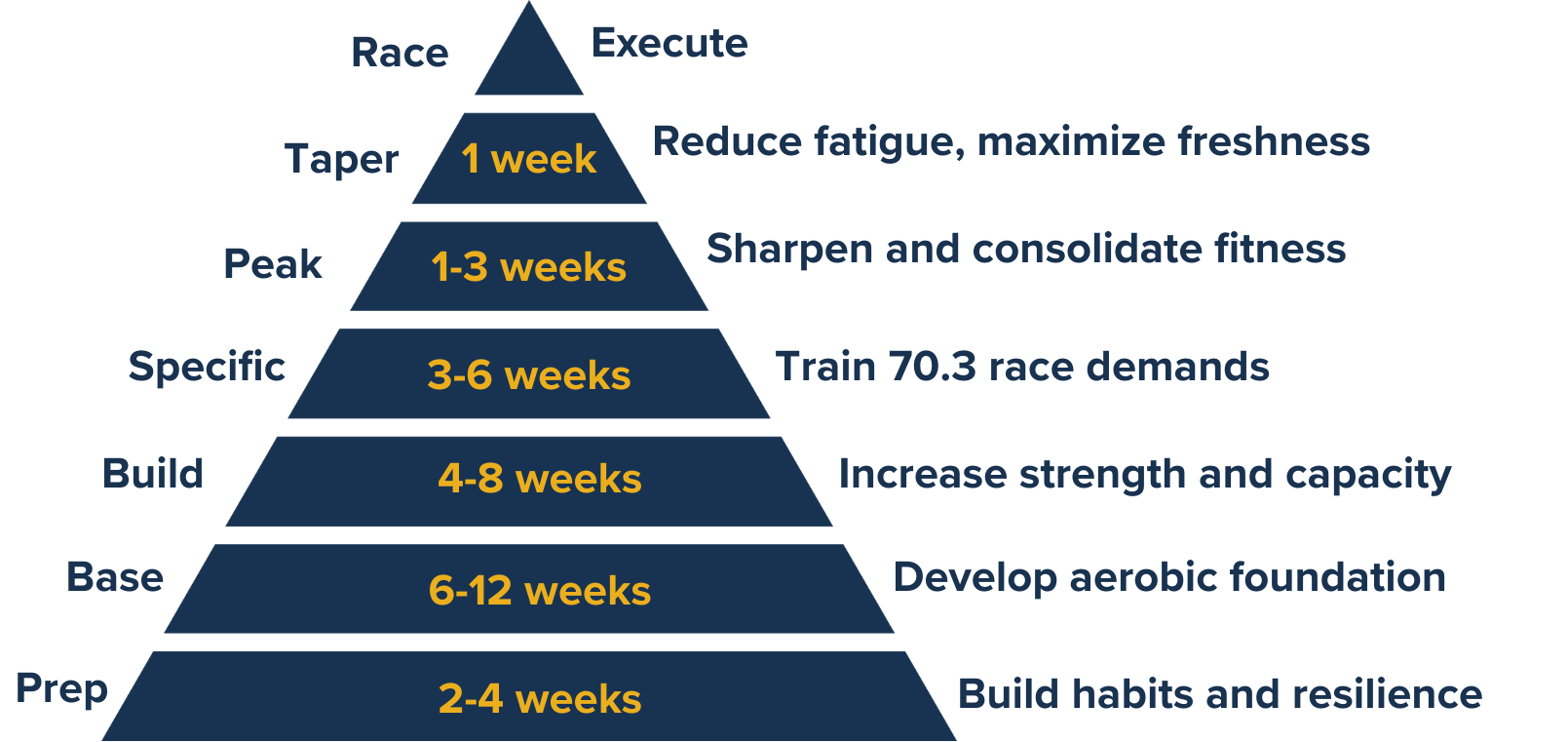
IRONMAN 70.3 training phases, purposes and duration
Weekly Training Time
IRONMAN 70.3 training does not require maximum volume every week. For most people, weekly training time typically ranges from 4 to 12 hours, depending on experience and the phase of training.
Early phases often sit closer to 4 to 6 hours per week, increasing gradually as fitness improves. Peak weeks may reach 9 to 12 hours, but these are temporary and supported by planned recovery weeks.
Every fourth week is usually reduced to allow fatigue to dissipate. These recovery weeks are non-negotiable and essential for long-term progress, and to avoid injury and burnout.
Even at peak training, 70.3 preparation usually takes up only a small percentage of total weekly time.
The challenge is not finding more hours, but using the available ones effectively.
What a Smart Training Week Looks Like
A well-designed 70.3 training week prioritises quality over exhaustion. Most weeks include a key speed session, a longer endurance session, and supporting aerobic work across swim, bike, and run.
Not every long ride needs to be easy, and not every weekend needs to be big. If every session feels hard, the plan is broken.
Strength training can be a valuable addition, but only once swim, bike, and run sessions are being completed consistently. Low-value sessions are removed in favour of workouts that drive the greatest return.
Common Pitfalls That Extend the Timeline
Many athletes undermine their 70.3 preparation by training hard when fatigued, letting work stress dictate training intensity, or treating recovery as optional. Others ignore nutrition until race day or chase weekly volume instead of long-term trends.
Avoiding these mistakes is often the difference between racing strongly through the final kilometres and simply hanging on.
Balancing Training With Real Life
Training for an IRONMAN 70.3 alongside a full-time job and family life is not about doing more. It is about doing the right things consistently.
The most effective plans are efficient, flexible, and built around real-world constraints such as travel, long workdays, and family commitments. Key sessions are protected, while lower-priority workouts remain adaptable.
This approach allows training to continue progressing even when life does not go to plan.
Final Thoughts
There is no single timeline that fits everyone, but for most busy professionals, four to eight months of structured, intelligent training provides the best chance of success at IRONMAN 70.3.
The aim of training is to arrive at the start line healthy, confident, and prepared to race with intent. With a smart plan, realistic expectations, and consistent execution, a 70.3 becomes a challenge you can train for without burning out your career, family, or body.