
How Long It Takes To Train For An IRONMAN
One of the most common questions athletes ask is how long it really takes to train for an IRONMAN. The honest answer is that it depends, not just on fitness, but on life. Work demands, family commitments, stress, and recovery capacity all play a major role in determining the right timeline.
For busy professionals, IRONMAN preparation is not about squeezing in as much training as possible. It is about building fitness in a sustainable way that keeps you healthy, consistent, and motivated all the way to the start line.
The Short Answer
For most people, preparing properly for an IRONMAN takes between 9 and 12 months. This timeframe allows fitness to be built gradually, habits to be established, and durability to develop without relying on extreme volume or intensity.
Athletes who are newer to triathlon, returning from injury, or managing high work or family stress generally benefit from the longer end of this range. Shorter plans often rely on aggressive training spikes that increase the risk of fatigue, inconsistency, injury, or burnout.
Athletes with a strong endurance background, such as experienced marathon runners or those who have recently completed a 70.3, may be able to prepare in 4 to 6 months. Even in these cases, success depends on smart sequencing and consistent execution rather than trying to do everything at once.
Why Longer Often Works Better
The biggest mistake age group athletes make is assuming that more training automatically leads to better results. In reality, consistency over time is far more powerful than short periods of heroic training.
Forty weeks of steady, well-managed training will almost always outperform sixteen weeks of rushed, high-stress preparation. Longer timelines allow your body to adapt, recover, and become resilient to the demands of race day, and help avoid injury and burnout along the way.
IRONMAN success is not about who trains the most. It is about who trains the smartest and arrives on the start line healthy, confident, and ready to perform.
The Structure of Ironman Preparation
Successful IRONMAN training follows a clear structure, with each phase building on the one before it. Skipping steps or rushing through phases reduces durability and increases the likelihood of problems late in the race.
Preparation typically begins with a phase focused on building habits, movement quality, and general resilience. This is followed by a base phase where aerobic fitness is developed. From there, training progresses into build and race-specific phases that increase strength, capacity, and familiarity with IRONMAN demands.
A peak phase sharpens fitness before a taper period reduces fatigue and allows freshness to emerge. Each layer supports the next, and none of them can be skipped without consequence.
Imagine you a building a pyramid and each workout is a brick that goes into the pyramid. You have to build from the bottom up, each brick at a time, to hold up the top of the pyramid.
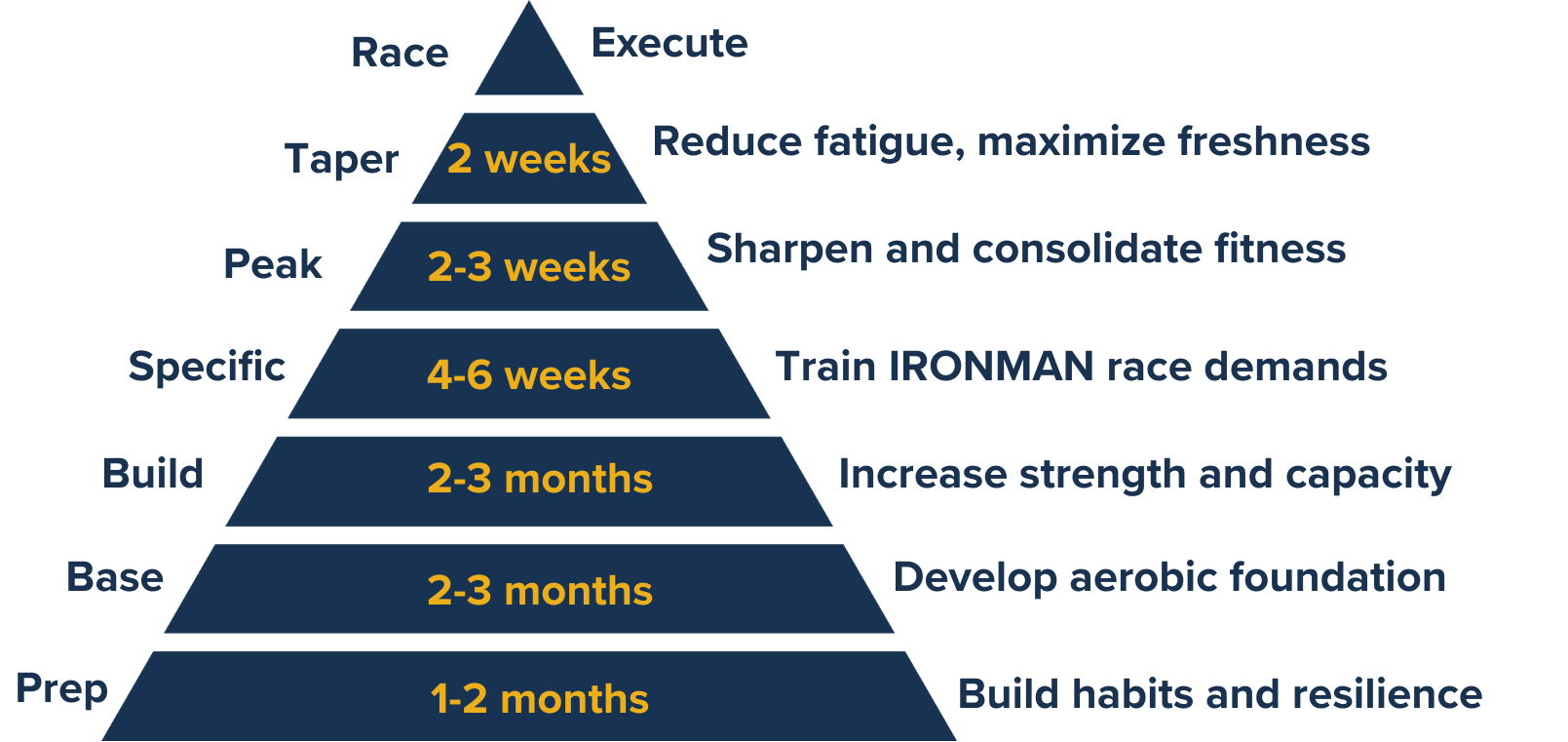
IRONMAN training phases, purposes and duration
Weekly Training Time
IRONMAN training does not require maximum volume every week. For most busy people, weekly training hours range from eight to eighteen depending on the phase of training, experience level, and available time.
Early phases often sit closer to eight to ten hours per week, gradually increasing as fitness and efficiency improve. Peak weeks may reach higher volumes, but these are temporary and supported by regular recovery weeks.
Every fourth week is typically reduced to allow fatigue to dissipate. These recovery weeks are non-negotiable and play a key role in long-term progress and avoiding injury and burnout.
It’s worth remembering that there are 168 hours in a week. Even at peak training, IRONMAN preparation usually accounts for a small percentage of total time.
The challenge is not finding more hours, but using the available ones effectively.
What a Smart Training Week Looks Like
A well-designed week prioritises quality and purpose over exhaustion. Most weeks include across swim, bike, and run:
a key endurance session
a focused intensity session
supporting aerobic work
Not every long ride needs to be easy, and not every weekend needs to be massive. If every session feels hard, the plan is broken.
Strength training can be valuable, but only once swim, bike, and run sessions are being completed consistently. Low-value or junk sessions are removed in favour of workouts that deliver the greatest return for time invested.
Common Pitfalls That Extend the Timeline
Many athletes unintentionally make IRONMAN training take longer by training hard when fatigued, letting work stress dictate intensity, or treating recovery as optional. Others delay learning nutrition strategies or chase weekly volume instead of long-term trends.
Avoiding these mistakes often makes the difference between finishing strong and simply surviving. Having a coach can help take out the guess work so you can maximise the training benefits.
Balancing Training With Real Life
Training for an IRONMAN alongside a full-time job, family and social life is not about doing more. It is about making better decisions more consistently.
The most effective plans are flexible, efficient, and built around real-world constraints like travel, long workdays, and family commitments. Key sessions are protected, while lower-priority workouts remain adaptable.
This approach allows training to continue progressing even when life does not go to plan.
Final Thoughts
There is no single timeline that works for everyone, but for most busy professionals, 9 to 12 months of structured, intelligent training provides the best chance of success.
IRONMAN preparation should build confidence, fitness, and resilience, not leave you exhausted or burnt out.
With a smart plan, realistic expectations, and consistent execution, the journey to the start line becomes manageable, sustainable, and rewarding.